 Treatment education · 8 November 2026
Sculptra: a considered guide
How poly-L-lactic acid works, what a treatment plan may involve, and the benefits, limitations and risks to discuss before deciding.
Read the article → Regulation · 28 October 2026
Aesthetic regulation is changing: why doctor-led care matters
England is consulting on tighter controls for certain high-risk cosmetic procedures. Here’s what is proposed, what is already in force, and why medical standards and individual competence matter.
Read the article → Clinic feature
Doctor-led aesthetic care
An introduction to Dr Clare’s aesthetic treatments, medical expertise and natural-results approach.
 Your first visit
What to expect from a consultation
A consultation is a chance to talk through what you hope to achieve, your medical history and any concerns. Dr Clare will explain suitable options, expected outcomes and possible risks, then give you time to ask questions and decide whether to proceed.
Plan your consultation → Treatment notes
A thoughtful approach to anti-wrinkle treatment
Every face moves differently. A medical assessment helps Dr Clare understand your goals, facial movement and suitability before discussing a treatment plan. The aim is a considered, natural-looking result, with clear information about expected effects, risks and aftercare.
Explore treatments → Clinic notes
Natural results begin with listening
Good aesthetic care starts with understanding the person, not choosing a procedure. Dr Clare listens to what matters to each client, makes an individual assessment and discusses whether treatment is appropriate. Sometimes the best plan is to wait, keep things simple or choose no treatment.
Our approach → Patient safety
Choosing a safe aesthetic practitioner
Recent reports of serious complications are a reminder to ask who will treat you, what product will be used and what support is available if something goes wrong.
Read the safety guide →Treatment education · Dr Clare Aesthetics · 8 November 2026Sculptra: a considered guide to gradual collagen support
Sculptra is an injectable treatment for adults seeking gradual support for facial volume and skin structure. Dr Clare has undertaken specialist training to provide this treatment. Here is a clear guide to how it works, what a course may involve, and the points to consider before deciding.
What is Sculptra?
Sculptra is a brand of injectable poly-L-lactic acid (PLLA). It is supplied as a sterile powder and prepared as a suspension by a trained healthcare professional. PLLA is biodegradable: after injection, the particles are gradually broken down by the body.
It is often described as a collagen biostimulator. Rather than acting as a ready-made gel that immediately fills a line, the suspension is intended to support a gradual tissue response. As connective tissue forms around the particles, collagen and elastin fibres build over time. These proteins help provide structure and support within the skin.
Some fullness can be visible just after treatment because of fluid and swelling. This early effect is temporary. The intended change develops gradually over the following weeks and months, so Sculptra is not a quick-fix treatment.
How is it different from a traditional filler?
Hyaluronic-acid fillers add volume directly with a gel and can create a more immediate change. Sculptra follows a different approach: it aims to encourage a gradual collagen response and may be considered when someone wants a slower change in facial support and volume.
Neither approach is automatically better. The right option depends on the area, your anatomy, health, goals and preferences. At consultation, Dr Clare can explain the differences, alternatives and limitations, including when another treatment or no treatment may be more appropriate.
What concerns and areas may be considered?
Following an individual assessment, Sculptra may be considered for selected areas affected by facial volume loss or skin creases. The product information lists areas such as the cheeks, temples, nasolabial folds, marionette lines and chin crease. Treatment suitability is assessed area by area; it is not appropriate for every concern or every part of the face.
Sculptra should not be injected into the red part of the lips or the area around the eyes. It is not a lip filler. Dr Clare will explain which areas are suitable and what a realistic outcome might be for you.
What happens at a consultation?
The consultation is an important part of care. Dr Clare will ask about your medical history, medicines, allergies, previous aesthetic procedures and what you hope to change. She will assess the treatment area, discuss whether Sculptra is suitable, and talk through expected effects, possible risks and alternatives.
You will have time to ask questions and consider the information. There is no pressure to proceed. If treatment is not suitable, or your expectations cannot reasonably be met, Dr Clare will explain that and discuss other options where appropriate.
What does treatment involve?
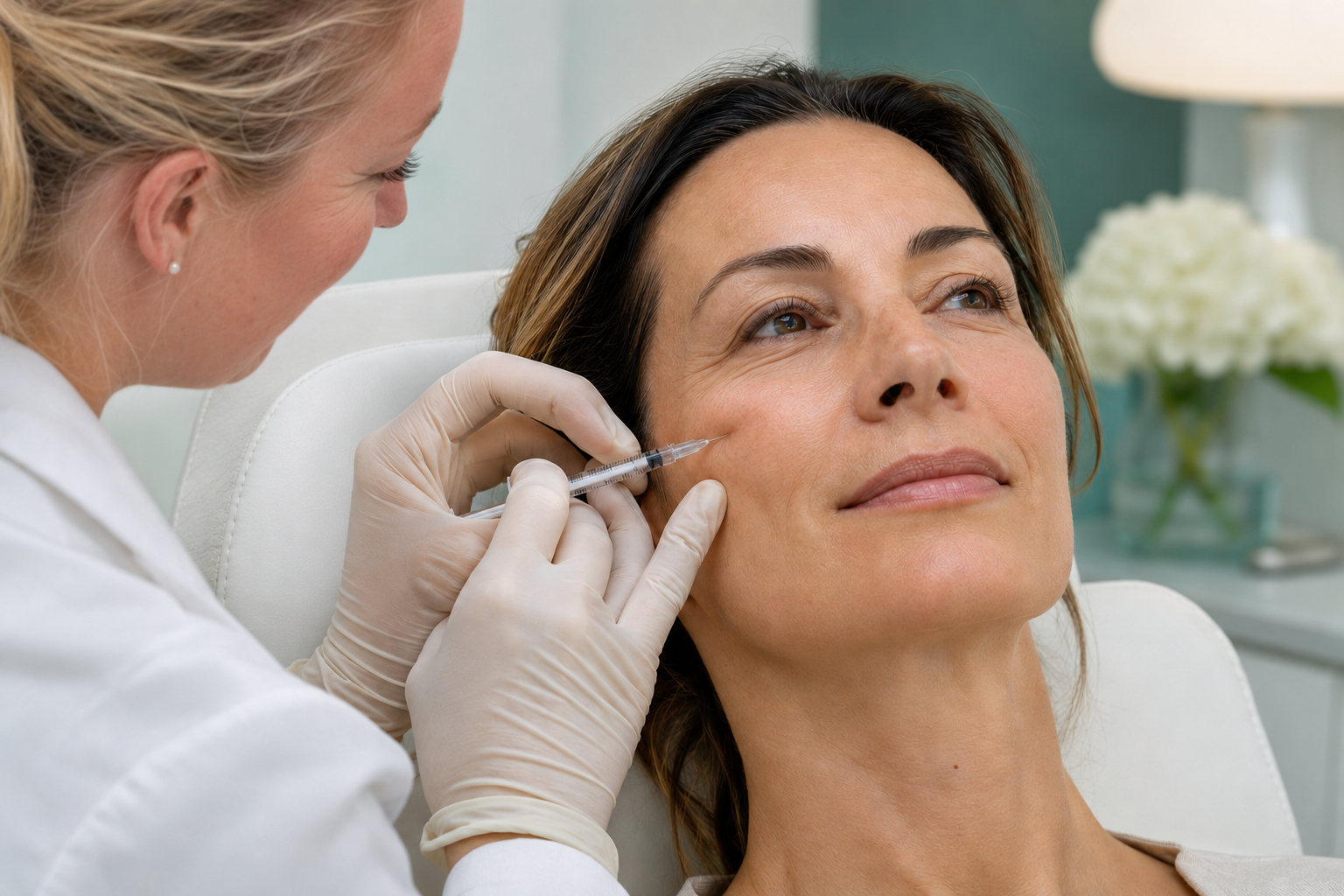
If you decide to proceed, the treatment area is cleaned and the product is prepared for that appointment. Sculptra is placed into selected tissue planes using a needle or cannula, depending on the area and clinical plan. Local anaesthetic may be used to improve comfort. Appointment length and the amount of product depend on the treatment plan.
Sculptra is commonly planned as a course rather than a single visit. The number and spacing of sessions vary, and the effect should be reviewed after each one before deciding whether more treatment is appropriate. Your personal schedule will be discussed with you; there is no one course that suits everybody.
When might I see a change, and how long can it last?
The treatment is designed to work gradually. Some people notice changes over the weeks following a session, with further change developing over time and after any additional sessions. A series of photographs, taken with your consent, can help you and Dr Clare review progress consistently.
Clinical and product information report that improvement can be long-lasting, sometimes for two years or more. Duration varies between people and depends on factors such as the treatment area, the plan and individual response. Results cannot be guaranteed, and maintenance treatment is a separate decision to discuss at review.
Who may be suitable?
Sculptra is for adults. Suitability depends on your health, skin, treatment area and goals. It may not be suitable if you have a known allergy to a product component, severe allergies, an active infection or inflammation near the proposed treatment area, or certain health conditions that need further consideration.
Safety has not been established in pregnancy or while breastfeeding. Tell Dr Clare about any autoimmune condition, immune-suppressing treatment, bleeding disorder, blood-thinning medicine, tendency to unusual scarring, previous implants or recent procedures in the area. Do not stop prescribed medicines unless the prescriber tells you to.
What are the risks?
As with any injection, short-term reactions can include tenderness or pain, redness, bruising, swelling, itching or small bumps at the injection sites. These often settle, but individual recovery varies.
Small lumps or nodules can sometimes develop beneath or within the skin, including weeks or months after treatment. Less commonly, there may be persistent inflammation, infection or abscess, unevenness, asymmetry, pigment change or a granuloma that needs medical assessment and treatment. Delayed reactions can occur, so the clinic should be contacted if anything unusual develops.
Rare but serious complications associated with injectable treatments include a blood-vessel blockage, skin injury and visual problems. Urgent assessment is needed for severe or unusual pain, blanching or dusky skin, or any change in vision after an injectable treatment. Dr Clare will discuss the warning signs and how to contact the clinic before treatment.
Aftercare and follow-up
Aftercare is tailored to the treatment and your individual plan. Product guidance may include gentle massage of the treated area for a short period after treatment, but follow the specific instructions Dr Clare gives you rather than relying on general advice online. A cool pack with a cloth barrier may be advised briefly for swelling.
Contact the clinic if you are worried about your recovery or notice an unexpected change. Your review appointment is an opportunity to assess the response, discuss any concerns and decide together whether further treatment is appropriate.
Further readingGalderma UK: Sculptra ·
British Cosmetic Dermatology Group: PLLA injections ·
Sculptra Instructions for UseThis article is for general information only. It does not replace a personal consultation or medical advice.
Clinic perspective · England · 28 October 2026Aesthetic regulation is changing: why doctor-led care matters
The rules around aesthetic practice are moving toward clearer safeguards. For clients, the important question is not just what treatment is offered, but who assesses you, who performs it, and how your safety is supported.
What is changing?
In October 2026, the Department of Health and Social Care opened a consultation on proposals to bring specified high-risk cosmetic and wellbeing procedures into Care Quality Commission (CQC) regulation. The draft would limit these procedures to specified regulated healthcare professionals, including doctors, dentists and independent prescribing nurses, midwives or pharmacists. It proposes that cosmetic surgery be performed by doctors only, and includes age restrictions with defined exceptions.
The proposed high-risk list includes certain deep chemical peels, dermal microcoring, intravenous procedures, specified laser and intense pulsed light treatments, non-resorbable facial fillers, some blood procedures such as PRP, and procedures involving a separate anaesthetic injection. The consultation is open until 13 January 2027. These are proposals, not a complete set of new rules already in force: final regulations will require parliamentary debate, and a transition period is expected before the new restrictions commence.
There is also a wider licensing plan
The government’s 2025 response to an earlier consultation committed to a local-authority licensing scheme for lower-risk non-surgical cosmetic procedures, alongside age restrictions. The details are still being developed. The 2026 consultation focuses first on the highest-risk procedures.
Why doctor-led care matters
In our view, doctor-led care is a strong way forward because it places treatment within a framework of medical assessment, professional accountability and clear standards. Doctors offering cosmetic interventions are already subject to GMC professional guidance: they must work within their competence, obtain consent themselves, explain benefits and risks, allow time for reflection, consider a person’s vulnerabilities and market services responsibly.
A professional title by itself is not a guarantee of competence. The government’s own proposals recognise that practitioners must work within their individual training and scope. A safe choice depends on the right experience for the specific treatment, careful assessment, suitable premises, honest discussion and reliable aftercare.
Questions clients can ask
- Who will assess me and who will carry out the treatment?
- What training and professional registration do they have for this procedure?
- What are the alternatives, likely benefits, risks and recovery?
- What aftercare and support are available if I have a concern?
At Dr Clare Aesthetics, every treatment begins with a doctor-led consultation and a personalised discussion. There is no pressure to proceed; informed decisions take time.
Official sources: DHSC high-risk procedures consultation · DHSC licensing consultation response · GMC cosmetic interventions guidance
This article summarises proposals and professional guidance as at 28 October 2026. It is general information, not legal advice. The rules may change as consultation and parliamentary processes continue.
Patient safety · Dr Clare AestheticsAesthetic treatment safety: questions to ask before you book
Reports of people becoming seriously unwell after cosmetic injections are deeply concerning. Whatever treatment you are considering, you deserve clear information, an appropriate clinical assessment and a practitioner who takes your questions seriously.
Social media posts and news reports can be distressing, and details may be incomplete while events are being investigated. The practical lesson is clear: take time to check who will treat you, what will be used and what arrangements are in place to care for you afterwards.
Before botulinum toxin treatment
Botulinum toxin injections are prescription-only medicines in the UK. Before going ahead, make sure you know who the prescriber is, who will administer the treatment, and how your suitability has been assessed. The NHS advises that treatment should only be prescribed after a consultation with a healthcare professional. The NMC requires independent nurse and midwife prescribers to conduct and document a face-to-face consultation and clinical assessment before prescribing medicines for elective non-surgical cosmetic procedures.
If a practitioner says they are a doctor or nurse, ask for their full name and registration details and check the relevant professional register. If someone else will administer your treatment, ask about their training and experience, and how the prescriber oversees your care.
Questions worth asking
- What is your professional registration, training and experience with this specific treatment?
- Who will assess me, prescribe the medicine if one is needed, and carry out the treatment?
- What is the product name, who makes it, and where has it come from?
- What are the likely benefits, alternatives, risks and aftercare?
- Who should I contact if I am worried, and how would a complication be managed?
You should be given enough information and time to make your own decision. Be cautious if the product is not identified, questions are brushed aside, or you feel pressured to proceed.
Dermal fillers are different, but still carry risks
Dermal fillers are not prescription-only medicines in the same way as botulinum toxin. That does not make them risk-free. Complications can include infection and damage to skin or other tissue; in rare cases, a complication can affect vision and cause blindness.
Ask which filler is proposed and where it came from. Check the practitioner’s relevant qualifications and experience, and ask what aftercare and emergency arrangements are available. You should understand the risks and have time to decide before consenting.
Choose informed care
A professional who puts your safety first will welcome reasonable questions and explain the answers plainly. You can pause, take information away or decide not to proceed.
At Dr Clare Aesthetics, care is led by Dr Clare, a Consultant Anaesthetist with more than 30 years of medical experience. Each recommendation follows an individual consultation, a review of relevant medical history and a discussion of suitability, options, risks and aftercare. There is no pressure to have treatment.
Your face. Your health. Your choice—and your decision should be an informed one.
Start with a consultation
Further information: NHS advice on choosing a practitioner · NMC guidance for prescribers · Check the NMC register · Check the GMC register
This article provides general information and does not replace individual medical advice. Guidance and regulation can change; check the linked official sources for current information.
Professional standardsWhat Save Face accreditation and BCAM membership mean
Dr Clare is an accredited Save Face practitioner and a member of the British College of Aesthetic Medicine (BCAM).
Save Face accreditation
Save Face assesses practitioners and their premises against its accreditation standards, including a 116-point assessment. It covers areas such as suitability of premises, practitioner competence, consent, patient information and aftercare. Accreditation gives clients an additional way to check a practitioner and raise concerns.
BCAM membership
BCAM is a professional membership body for doctors and dentists practising aesthetic medicine. It sets membership criteria that include appropriate GMC or GDC registration and aesthetic experience, and supports members’ ongoing education and professional development. Membership is a professional affiliation; it does not mean BCAM has approved every treatment or guarantees an outcome.
These credentials sit alongside Dr Clare’s GMC registration and more than 30 years of medical experience. Clients should still discuss the risks, alternatives and suitability of any treatment at consultation.
Your care, at your paceClient information
Your consultation is a chance to discuss your goals, medical history, suitability and any questions. Treatment-specific preparation and aftercare guidance is provided by Dr Clare for your individual plan.
Contact the clinic for guidance → Visit by appointmentFind us in Rowington, Warwick
Warwick Lodge, Old Warwick Road, Rowington, Warwick, CV35 7AA
Our lovely countryside clinic has discreet private parking, ground-floor access and WC facilities. Wi-Fi is available. Please follow the directions below as the entrance is easy to miss.
What3Words: ///custom.evaded.somewhere
Open directions in Google Maps From the A46Approaching from Warwick
Follow the local signs towards Rowington and Old Warwick Road. As you approach, look for the RDA riding school on your left. The clinic driveway is the next right as you go downhill. Turn in, bear right up the drive and park in the gravel parking area. The clinic is in the separate annexe.
From the M42Via Hockley Heath
Leave the M42 at Junction 4 and follow the A3400 towards Hockley Heath. Continue towards Rowington and Old Warwick Road. After the bends, as you begin to climb the hill, the clinic driveway is the second entrance on the left. Bear right up the drive and park in the gravel area; the clinic is in the separate annexe.
A few helpful answers
Frequently asked
What happens at a consultation?
Dr Clare will listen to your concerns and goals, discuss your medical history, assess suitability and explain options. There is no pressure to proceed.
Where is the clinic?
The clinic is in Rowington, Warwick. Full visit details are provided when your appointment is arranged.
Why choose doctor-led aesthetic care?
Doctor-led care brings medical assessment into the treatment journey. Dr Clare can review your health, medicines and suitability, explain benefits and risks, and discuss alternatives before recommending a personalised plan. Her GMC registration and over 30 years of medical experience inform this careful approach.
Will I need a consultation before treatment?
Yes. A consultation is a chance to discuss your goals, medical history and options, and to ask questions. Dr Clare will explain what is suitable and what to expect.
What should I expect after treatment?
Aftercare and recovery depend on the treatment. Dr Clare will provide instructions tailored to you. Contact the clinic if you are unsure about your aftercare or concerned about a symptom.
Do you offer a personalised treatment plan?
Yes. Recommendations are based on your consultation, priorities and suitability. You can discuss options, expected outcomes and pricing before deciding.
How do I book?
Book an appointment online
Client experiencesGoogle Reviews
Kind words shared by clients on Google.
5.0★★★★★22 Google reviews
★★★★★
“So knowledgeable & reassuring”
Google review
★★★★★
“So happy with the results”
Google review
★★★★★
“Each consultation is incredibly thorough”
Google review
GOOGLE REVIEWS ★★★★★ 5.0 · 22 reviews“So knowledgeable & reassuring”“So happy with the results”“Each consultation is incredibly thorough”Read all Google reviews ↗ GOOGLE REVIEWS ★★★★★ 5.0 · 22 reviews“So knowledgeable & reassuring”“So happy with the results”“Each consultation is incredibly thorough”Read all Google reviews ↗